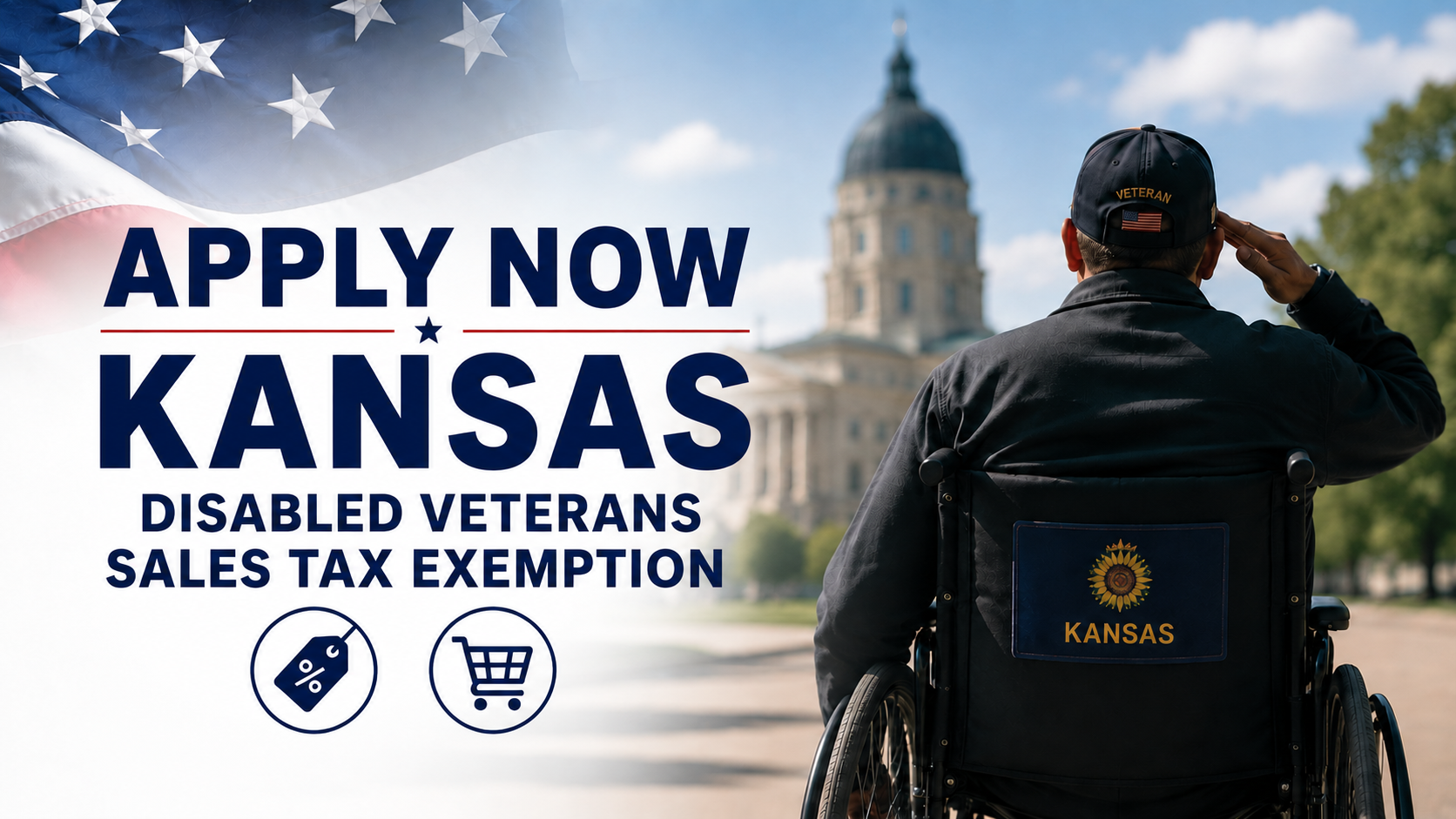
Kansas Creates New Sales Tax Exemption for Certain Disabled Veterans
Kansas has enacted a new sales tax exemption for certain disabled veterans, with qualifying purchases exempt beginning July 1, 2026. The exemption was enacted in 2024 and is codified as K.S.A. 79-3606h under 2024 Kansas Chapter 94 §1.
Who Qualifies?
To qualify, an individual generally must be:
- A Kansas resident;
- Honorably discharged from active service in a branch of the U.S. armed forces; and
- Certified by the U.S. Department of Veterans Affairs as having a permanent 100% disability or as being totally disabled or unemployable due to qualifying service-related causes.
The Kansas Department of Revenue states that applicants should be prepared to provide documentation such as a DD Form 214 and a VA Award Letter or VA Benefit Summary Letter showing qualifying disability status.
Surviving Spouses
A surviving spouse may continue to use the exemption if the eligible veteran was receiving the exemption at the time of death. The surviving spouse remains eligible until remarriage. KDOR guidance further states that the veteran must have died on or after July 1, 2026 for the surviving spouse to qualify.
What Purchases Are Covered?
The exemption generally applies to sales of tangible personal property and services purchased for the personal use of the eligible veteran, the veteran’s spouse, or qualifying surviving spouse. Purchases made on behalf of the eligible person by a spouse or authorized household member may also qualify.
Examples of potentially qualifying purchases include everyday personal items such as food, clothing, toiletries, appliances, over-the-counter medications, and restaurant purchases other than alcohol.
What Is Not Covered?
The exemption does not apply to:
- Motor vehicles;
- Alcoholic beverages;
- Tobacco;
- Electronic cigarettes;
- Consumable materials for electronic cigarettes; or
- Purchases used for producing income, including business, farming, or hobby-income uses.
KDOR notes that while the purchase of a motor vehicle is excluded, vehicle repairs, maintenance, modifications, parts, and labor may qualify if otherwise used for personal purposes.
Annual Cap and Required Card
Qualifying exempt purchases are limited to $24,000 per eligible person per year. KDOR explains that this is a purchase cap, not a tax-savings cap.
Before claiming the exemption, an eligible person must apply to the Kansas Secretary of Revenue for a veteran exemption identification number. Approved applicants receive a driver’s-license-sized exemption card, which must be presented to retailers—or the identification number entered on the retailer’s exemption certificate—when claiming the exemption. KDOR recommends applying online and also provides Form K-97, Application for Disabled Veteran Sales Tax Exemption.
Practical Reminders
For taxpayers:
Track exempt purchases during the year to avoid exceeding the $24,000 annual limit. If requested, the taxpayer may need to provide a sworn statement confirming that the annual limit has not been exceeded; tax on excess purchases may be assessed as a direct liability.
For retailers:
The exemption should be allowed only when the purchaser presents the required exemption card or provides the assigned exemption identification number on a valid exemption certificate. Retailers should document the purchase and exemption information in their records and remember that excluded items—such as motor vehicles, alcohol, tobacco, and e-cigarette products—remain taxable even if purchased by an otherwise eligible veteran.
For more information, go to the KDOR website at Kansas Department of Revenue – Disabled Veteran Tax Exemption or call your tax advisor at Larson & Company, Inc. at (316) 263-8030.