Tax and Accounting News

Kansas Creates New Sales Tax Exemption for Certain Disabled Veterans

Kansas Creates New Sales Tax Exemption for Certain Disabled Veterans

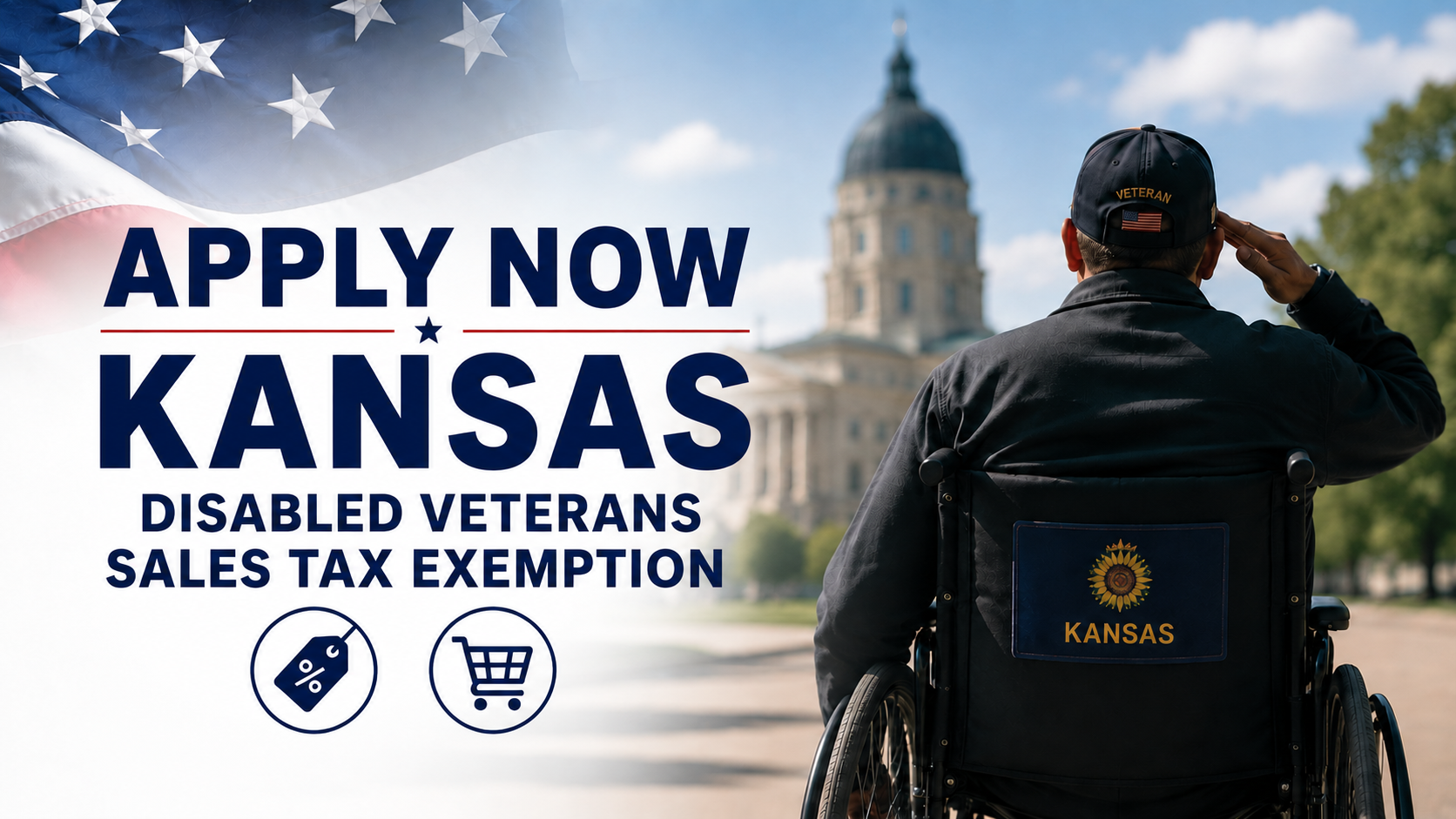
Kansas has enacted a new sales tax exemption for certain disabled veterans, with qualifying purchases exempt beginning July 1, 2026. The exemption was enacted in 2024 and is codified as K.S.A. 79-3606h under 2024 Kansas Chapter 94 §1.

Who Qualifies?

To qualify, an individual generally must be:

  • A Kansas resident;
  • Honorably discharged from active service in a branch of the U.S. armed forces; and
  • Certified by the U.S. Department of Veterans Affairs as having a permanent 100% disability or as being totally disabled or unemployable due to qualifying service-related causes.

The Kansas Department of Revenue states that applicants should be prepared to provide documentation such as a DD Form 214 and a VA Award Letter or VA Benefit Summary Letter showing qualifying disability status.

Surviving Spouses

A surviving spouse may continue to use the exemption if the eligible veteran was receiving the exemption at the time of death. The surviving spouse remains eligible until remarriage. KDOR guidance further states that the veteran must have died on or after July 1, 2026 for the surviving spouse to qualify.

What Purchases Are Covered?

The exemption generally applies to sales of tangible personal property and services purchased for the personal use of the eligible veteran, the veteran’s spouse, or qualifying surviving spouse. Purchases made on behalf of the eligible person by a spouse or authorized household member may also qualify.

Examples of potentially qualifying purchases include everyday personal items such as food, clothing, toiletries, appliances, over-the-counter medications, and restaurant purchases other than alcohol.

What Is Not Covered?

The exemption does not apply to:

  • Motor vehicles;
  • Alcoholic beverages;
  • Tobacco;
  • Electronic cigarettes;
  • Consumable materials for electronic cigarettes; or
  • Purchases used for producing income, including business, farming, or hobby-income uses.

KDOR notes that while the purchase of a motor vehicle is excluded, vehicle repairs, maintenance, modifications, parts, and labor may qualify if otherwise used for personal purposes.

Annual Cap and Required Card

Qualifying exempt purchases are limited to $24,000 per eligible person per year.  KDOR explains that this is a purchase cap, not a tax-savings cap.

Before claiming the exemption, an eligible person must apply to the Kansas Secretary of Revenue for a veteran exemption identification number. Approved applicants receive a driver’s-license-sized exemption card, which must be presented to retailers—or the identification number entered on the retailer’s exemption certificate—when claiming the exemption. KDOR recommends applying online and also provides Form K-97, Application for Disabled Veteran Sales Tax Exemption.

Practical Reminders

For taxpayers:

Track exempt purchases during the year to avoid exceeding the $24,000 annual limit. If requested, the taxpayer may need to provide a sworn statement confirming that the annual limit has not been exceeded; tax on excess purchases may be assessed as a direct liability.

For retailers:

The exemption should be allowed only when the purchaser presents the required exemption card or provides the assigned exemption identification number on a valid exemption certificate. Retailers should document the purchase and exemption information in their records and remember that excluded items—such as motor vehicles, alcohol, tobacco, and e-cigarette products—remain taxable even if purchased by an otherwise eligible veteran.


For more information, go to the KDOR website at Kansas Department of Revenue – Disabled Veteran Tax Exemption or call your tax advisor at Larson & Company, Inc. at (316) 263-8030.
New Mileage Rates for 2026

Beginning Jan. 1, 2026, the standard mileage rates for the use of a car, van, pickup or panel truck will be:

  • 72.5 cents per mile driven for business use, up 2.5 cents from 2025.
  • 20.5 cents per mile driven for medical purposes, down a half cent from 2025.
  • 20.5 cents per mile driven for moving purposes for certain active-duty members of the Armed Forces (and now certain members of the intelligence community), reduced by a half cent from last year.
  • 14 cents per mile driven in service of charitable organizations, equal to the rate in 2025.

The rates apply to fully-electric and hybrid automobiles, as well as gasoline and diesel-powered vehicles.

IRS Releases Updated Contingency Plan

The IRS has updated its contingency lapse plan, detailing how operations will proceed past the first five days of the federal government shutdown. The plan, which took effect on Oct. 8, 2025, outlines which functions will continue, which will pause and how employees will be managed during a prolonged shutdown scenario through April 2026. Despite the impending employee furlough, the IRS maintains it will continue to protect government property and data systems, issue certificates of U.S. residency and maintain connections with other federal agencies such as Social Security and OPM.

The IRS will continue with other core services:

  • Testing and completing the upcoming filing year programs
  • Processing returns with payments
  • Processing remittances to include payment perfection
  • Processing disaster relief transcripts
  • Designing and printing of tax forms

The following activities are furloughed and will NOT be conducted:

  • Issuing refunds
  • Processing non-disaster relief transcripts, and income verification services including express service/return
  • Processing individual amended returns
  • All audit functions, examining returns and processing non-electronic tax returns that do not include remittances
  • Non-automated collections
  • Legal counsel for non-excepted activities
  • Taxpayer services such as responding to taxpayer questions (call sites)
  • The Taxpayer Advocate Service is closed

Out of approximately 74,299 employees, about 39,870 (53.6%) will remain working under “exempt” or “excepted” status. These include positions funded by multi-year appropriations, legally authorized activities, or roles necessary to protect life, property or taxpayer data.

Once appropriations resume, furloughed employees will be recalled within hours under a structured communication plan. The IRS has released additional detailed information for its employees on the employee emergency news web page. The IRS will amend the plan as needed as the shutdown continues or if there is a presidentially-declared federal disaster, in which case, the IRS will support FEMA with call center assistance

Corporate Transparency Act

On 03/21/25, the Financial Crimes Enforcement Network (FinCEN) issued an interim final rule (IFR) that removes the requirement for U.S companies and U.S. persons to report beneficial ownership information (BOI) to FinCEN under the Corporate Transparency Act.

In this interim final rule, FinCEN revises the definition of “reporting company” in its implementing regulations to mean only those entities that are formed under the law of a foreign country and that have registered to do business in any U.S. State or Tribal jurisdiction by the filing of a document with a secretary of state or similar office (formerly know as “foreign reporting companies”).  FinCEN also exempts entities previously know as “domestic reporting companies” from BOI reporting requirement.

Thus, through this interim final rule, all entities created in the United States–including those previously know as “domestic reporting companies”–and their beneficial owners will be exempt from the requirement to report BOI to FinCEN.  Foreign entities that meet the new definition of a “reporting company” and do not qualify for an exemption from the reporting requirement must report their BOI to FinCEN under new deadlines,.  These foreign entities, however, will not be required to report any U.S. persons as beneficial owners, and U.S. persons will not be required to report BOI with respect to any such entity for which they are a beneficial owner.

Upon the publication of the interim final rule, the following deadlines apply for foreign entities that are reporting companies:

  • Reporting companies registered to do business in the United States before the date of publication of the IFR must file BOI reports no later than 30 days from that date.
  • Reporting companies registered to do business in the United States on or after the date of publication of the IFR have 30 calendar days to file an initial BOI report after receiving notice that their registration is effective.

Continue reading “Corporate Transparency Act”

New Login System

 What you need to know:

  • You’ll need to create a new username and password. To do this, you’ll need your current NetClient CS login ID and password. If you’ve saved these details to your browser, please memorialize them. If you’ve forgotten your login ID, please contact our office and ask for Vicki Jones.
  • The sign-in page will look different but will function the same way. This video showcases the new experience. Please watch this video as it is very helpful.
  • You’ll need to enable two-factor authentication. There are several options available to verify your identity when you log in. One option is the Auth0 Guardian mobile app, which is free on the Apple App Store for iOS and Google Play Store for Android. Learn more about two-factor authentication.
  • We recommend using the option that will send a text message to your phone. This method may be more familiar and is commonly used for two-factor authentication.